Product Description:
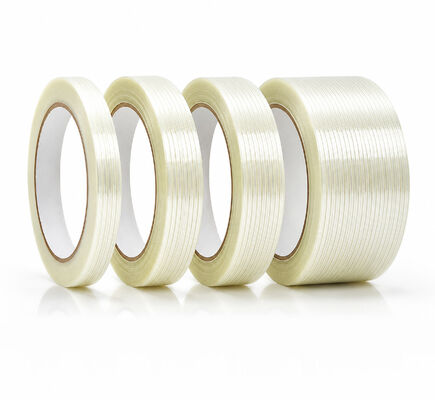
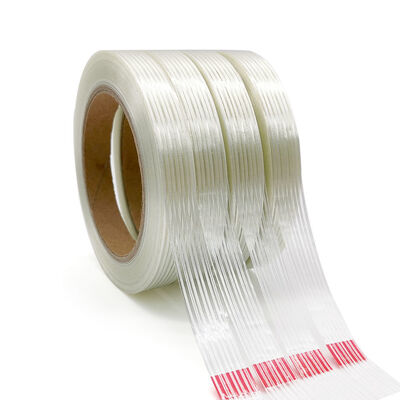
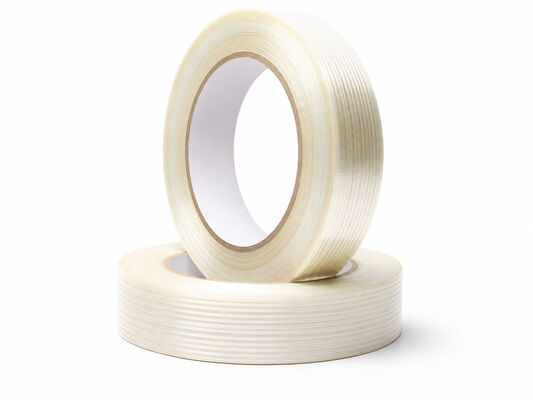
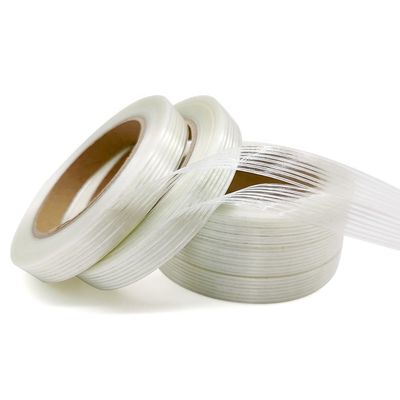
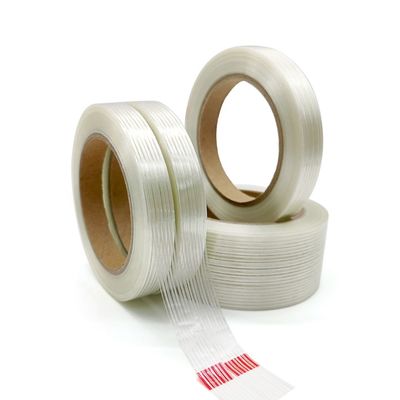
Mono Filament Tape is an industrial fiberglass reinforced adhesive tape developed for securing, strapping, reinforcing, and stabilizing products exposed to significant tensile forces. Its characteristic construction combines a durable film carrier, continuous glass fiber filaments positioned mainly in one direction, and a pressure-sensitive adhesive. The parallel reinforcement allows Mono Filament Tape to deliver strong machine-direction tensile performance while keeping the overall tape construction compact and easy to apply.
For packaging engineers and industrial buyers, one of the primary benefits of Mono Filament Tape is its ability to convert a relatively thin adhesive tape into an effective mechanical reinforcement material. When applied around a carton, bundle, profile, or component, the fiberglass strands absorb much of the tensile load and help restrict unwanted stretching. This can improve package stability during lifting, stacking, warehouse handling, truck transportation, and other logistics processes.
Mono Filament Tape is particularly useful in applications where forces act predominantly along the length of the tape. This distinguishes it from cross reinforced filament tapes, which use fibers in multiple directions to provide additional transverse tear resistance. For straightforward strapping and bundling operations, the mono-directional structure can provide an efficient combination of strength, material usage, and processing convenience.
Industrial applications extend beyond carton packaging. Mono Filament Tape can be used to secure appliance components during transportation, bundle metal or plastic profiles, reinforce corrugated packaging, stabilize rolls and coiled materials, group industrial components, and temporarily hold selected parts during manufacturing. Different adhesive technologies can be selected to address requirements such as high initial tack, sustained holding power, clean removal, or adhesion to specific substrates.
For sourcing and specification purposes, the product may also be described as Mono Filament Strapping Tape, Unidirectional Filament Tape, Fiberglass Strapping Tape, Glass Fiber Reinforced Tape, Heavy Duty Reinforced Tape, or Industrial Filament Tape. By combining pressure-sensitive adhesion with fiberglass reinforcement, Mono Filament Tape provides manufacturers, distributors, logistics companies, and packaging professionals with a practical solution for demanding reinforcement and load-retention tasks.
Features:
- Parallel Glass Fiber Construction: Mono Filament Tape incorporates continuous fiberglass yarns aligned predominantly along the tape length, creating concentrated tensile reinforcement for strapping and securing operations where the principal force follows the machine direction.
- Excellent Load Retention: The low-stretch reinforced structure helps maintain tension after application, reducing the likelihood that packages or bundled materials will loosen as a result of vibration, movement, or repeated handling.
- High Breaking Strength: Fiberglass reinforcement significantly increases mechanical strength compared with conventional non-reinforced packaging tapes, enabling the tape to support demanding industrial reinforcement and bundling requirements.
- Strong Initial Tack: Depending on the adhesive formulation, Mono Filament Tape can provide rapid wet-out and initial grip on suitable substrates, supporting efficient manual or production-line application.
- Reliable Shear Holding: A properly selected adhesive system helps resist creeping or displacement when the tape remains under sustained tension, an important characteristic for bundling, appliance fixation, and long-distance shipping.
- Low Elongation: Continuous glass fibers limit stretching when mechanical force is applied, helping maintain package geometry and more consistent compression around bundled products.
- Durable Film Carrier: The film backing protects the fiberglass reinforcement and contributes to abrasion resistance, processing stability, and reliable tape application in industrial environments.
- Efficient Alternative For Selected Strapping Tasks: In suitable light-to-heavy reinforcement applications, Mono Filament Tape can simplify packaging compared with bulkier fastening solutions while providing clean, compact, pressure-sensitive application.
- Suitable For High Speed Packaging Processes: Consistent roll construction and pressure-sensitive application make appropriate grades suitable for integration into manual dispensers and compatible industrial tape application systems.
- Wide Specification Range: Different tape widths, thicknesses, roll lengths, filament densities, adhesive types, tensile strengths, and core dimensions can be produced to match specific packaging or manufacturing requirements.
- Adaptable Adhesive Performance: Adhesive selection can be optimized for corrugated cardboard, plastics, metal, painted components, wood-based materials, and other substrates according to the required application conditions.

Technical Parameters:
| Place |
China |
| Water Resistance |
Excellent |
| Sample |
Freely Provided |
| Product Type |
Single Side |
| Stripe |
Mono, Bi-Directional |
| Size |
Custom |
| Use |
Carton Sealing, Heavy Duty Packing, Securing Lithium-ion Batteries, Fixing Large Electrical Appliances |
| Usage |
Packing, Sealing, Strapping, Fixing |
| Tape Width |
Customize |
The Reinforced Seam Fiberglass Tape is designed to provide exceptional durability and water resistance. This Reinforced Seam Fiberglass Tape is ideal for various applications including packing, sealing, and securing heavy-duty items. Our Reinforced Seam Fiberglass Tape ensures reliable performance for all your sealing and fixing needs.
Applications:
- Carton Strapping: Mono Filament Tape can be wrapped around heavy corrugated cartons to increase package security and reduce the risk of cartons opening when exposed to lifting, stacking, and transportation forces.
- Box Seam Reinforcement: Applying reinforced tape across critical seams can strengthen packaging areas subjected to concentrated mechanical stress and provide additional support beyond standard carton sealing tape.
- Handle Hole Reinforcement: Corrugated hand holes and lifting areas can be reinforced with Mono Filament Tape to distribute carrying loads and reduce tearing around frequently stressed carton sections.
- Bundling Pipes And Tubes: Plastic tubing, metal pipes, rods, conduits, and similar elongated products can be grouped securely because the tape provides strong longitudinal resistance to stretching and breakage.
- Securing Metal And Plastic Profiles: Aluminum extrusions, steel profiles, plastic sections, wooden moldings, and other long components can be bundled during production, warehousing, or shipment.
- Appliance Transportation Fixation: Manufacturers can use suitable Mono Filament Tape to secure drawers, trays, shelves, doors, cables, and removable components of household or commercial appliances before transportation.
- Paper And Corrugated Industry: Rolls, sheets, flattened cartons, corrugated components, and packaging blanks can be bundled or stabilized for internal movement and distribution.
- Furniture Component Securing: Flat-packed furniture, wooden panels, frames, decorative profiles, and related components can be temporarily held or bundled during processing and logistics.
- Automotive Supply Chain Packaging: Selected automotive components, replacement parts, hoses, profiles, and assemblies can be bundled or reinforced for warehouse handling and transportation.
- Cable And Wire Bundling: Heavy cable groups, wiring materials, and industrial conductors can be organized and temporarily secured when the tape specification is compatible with the application.
- Warehouse Unitization: Multiple cartons or products can be grouped into manageable handling units, improving organization during storage, picking, internal transportation, and order fulfillment.
- Export Packaging Reinforcement: Mono Filament Tape can provide an additional layer of mechanical security for packages exposed to extended transportation, repeated handling, container loading, or distribution through multiple logistics stages.
FAQ:
A: What is Mono Filament Tape used for?
Q: Mono Filament Tape is primarily used for carton strapping, industrial bundling, package reinforcement, appliance component fixation, profile securing, warehouse unitization, and other applications that require high longitudinal tensile strength and low elongation.
A: How does Mono Filament Tape work?
Q: The continuous fiberglass filaments carry tensile forces along the tape length while the pressure-sensitive adhesive anchors the tape to the package or component. This combination provides both mechanical reinforcement and surface adhesion.
A: What does mono mean in Mono Filament Tape?
Q: Mono refers to the primarily unidirectional arrangement of the fiberglass reinforcement. The glass fibers are aligned mainly along the machine direction rather than forming a cross pattern.
A: What are the benefits of unidirectional fiberglass reinforcement?
Q: Unidirectional reinforcement concentrates tensile strength along the length of the tape. This is particularly efficient for strapping, wrapping, and bundling operations where most of the load acts in the same direction.
A: What is the difference between Mono Filament Tape and normal packing tape?
Q: Normal packing tape primarily depends on its plastic film backing for mechanical strength. Mono Filament Tape contains continuous fiberglass reinforcement, which provides much greater tensile strength and lower elongation for demanding packaging applications.
A: When should I use Mono Filament Tape instead of Cross Filament Tape?
Q: Mono Filament Tape is suitable when high longitudinal tensile strength is the main requirement, such as carton strapping and bundling long products. Cross Filament Tape may be preferred when strong tear resistance is also required across the width of the tape.
A: Is Mono Filament Tape suitable for heavy packages?
Q: Yes, appropriate grades are commonly used for heavy carton reinforcement and industrial bundling. Buyers should select the required tensile strength, width, adhesive type, and reinforcement level according to actual package weight and handling conditions.
A: Can Mono Filament Tape maintain tension during transportation?
Q: Its fiberglass reinforcement provides low elongation, which helps the tape retain tension during vibration and repeated handling. Actual holding performance also depends on adhesive quality, surface condition, application pressure, temperature, and load.
A: Can Mono Filament Tape stick to plastic or metal?
Q: Suitable adhesive formulations can bond to many plastic, metal, painted, and corrugated surfaces. Because surface energy and coatings vary, adhesion testing on the actual substrate is recommended before production use.
A: Can Mono Filament Tape be used for removable appliance fixation?
Q: Certain tape constructions may be designed for temporary transportation fixation. When clean removal is important, buyers should specifically request a suitable adhesive system and evaluate residue performance on the actual appliance surface.
A: What tensile strength should I choose for Mono Filament Tape?
Q: The required tensile strength depends on package weight, load geometry, number of tape wraps, transportation stress, safety requirements, and application method. Industrial buyers should provide these conditions when selecting a tape specification.
A: What should be checked before purchasing Mono Filament Tape?
Q: Important specifications include backing material, total thickness, filament density, tensile strength, elongation, adhesion, adhesive chemistry, roll width, roll length, application temperature, substrate compatibility, and required holding duration.
A: Is Mono Filament Tape suitable for automatic packaging equipment?
Q: Certain roll formats and tape specifications can be used with compatible automatic or semi-automatic application equipment. Machine compatibility, unwind characteristics, roll dimensions, and cutting requirements should be confirmed before use.
A: Can Mono Filament Tape be supplied in customized dimensions?
Q: Yes. Width, length, thickness, adhesive formulation, reinforcement density, tensile strength, core dimensions, labeling, and packaging can be customized for OEM customers, industrial distributors, converters, and bulk purchasing programs.


 Your message must be between 20-3,000 characters!
 English