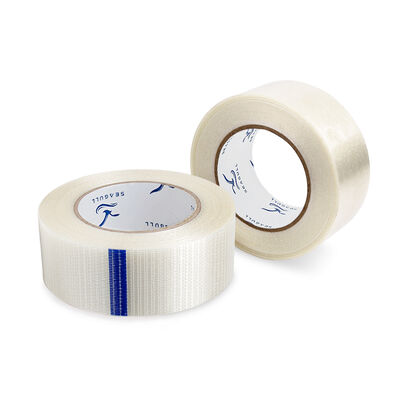
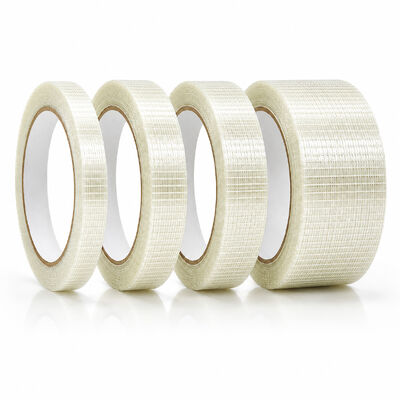
Product Description:
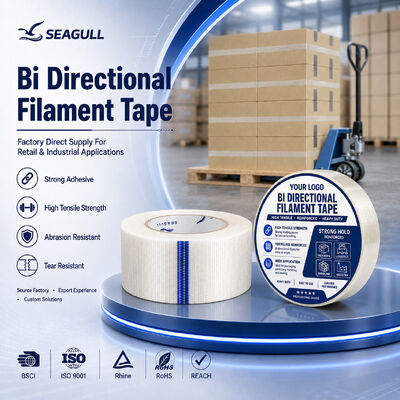
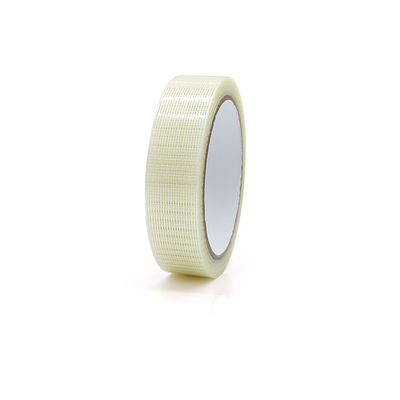
Bi Directional Filament Tape is a fiberglass reinforced pressure-sensitive tape engineered to provide mechanical strength in both the longitudinal and transverse directions. Unlike conventional reinforced tapes that concentrate most of their tensile strength along a single axis, Bi Directional Filament Tape incorporates intersecting glass fiber filaments to create a more balanced reinforcement structure. This design helps the tape resist pulling, splitting, tearing, and deformation when packages or components are exposed to forces from different directions.
The bi-directional reinforcement concept is particularly valuable in real-world industrial packaging, where mechanical stress rarely occurs in only one direction. Cartons can expand under internal pressure, bundles may twist during lifting, components can shift during transportation, and package corners may experience impact during loading and unloading. The intersecting fiberglass network helps distribute these forces over a broader area of the tape and supports package integrity under dynamic handling conditions.
Bi Directional Filament Tape typically combines a tough film backing, high-strength fiberglass reinforcement, and a pressure-sensitive adhesive. The backing provides a stable carrier for the fiber structure, while the adhesive anchors the reinforced tape to the substrate. Depending on the intended application, different adhesive systems can be selected to provide the required balance of initial tack, holding power, surface compatibility, and removability.
Because strength is provided across two axes, Bi Directional Filament Tape is well suited to reinforced carton sealing, heavy package stabilization, irregular product bundling, pallet load reinforcement, industrial component fixation, appliance transportation, and export packaging. It can also be applied selectively to vulnerable packaging areas such as handles, openings, corners, folds, and seams.
For B2B sourcing, Bi Directional Filament Tape may also be described as Bi Directional Fiberglass Tape, Cross Reinforced Filament Tape, Cross Weave Strapping Tape, Two Way Filament Tape, Fiberglass Reinforced Packaging Tape, or Heavy Duty Reinforced Strapping Tape. Manufacturers, converters, packaging distributors, logistics companies, and industrial users can select different constructions according to load conditions, substrate type, application method, required tensile performance, and transportation environment.
Features:
- Balanced Two Direction Reinforcement: Bi Directional Filament Tape incorporates fiberglass filaments in both longitudinal and transverse directions, helping distribute mechanical stress across the tape structure instead of concentrating strength along only one axis.
- High Resistance To Splitting: Transverse glass fibers help restrict splits from spreading across the tape width, providing additional security for packages that experience edge stress, lateral movement, or uneven loading.
- Strong Tensile Performance: The reinforced fiberglass network allows Bi Directional Filament Tape to withstand substantial pulling forces, making it suitable for demanding carton reinforcement, bundling, unitizing, and industrial securing applications.
- Improved Cross Direction Strength: Additional reinforcement across the width of the tape provides greater resistance to transverse forces than conventional mono-directional filament tape, helping the tape remain intact when loads shift or twist.
- Low Elongation Under Stress: Fiberglass reinforcement minimizes excessive stretching, enabling the tape to retain tension and support stable package geometry during handling, storage, and transportation.
- Resistance To Tear Propagation: The intersecting filament pattern can help prevent localized edge damage or small tears from quickly developing across the entire width of the tape.
- Reliable Pressure Sensitive Bonding: Different adhesive formulations can provide strong initial adhesion and sustained holding power on suitable corrugated board, plastic, metal, painted, and other industrial surfaces.
- Enhanced Dynamic Load Performance: Bi Directional Filament Tape is particularly useful where packages experience vibration, repeated movement, impact, or changing stress directions throughout the logistics process.
- Reinforcement Without Excessive Bulk: The fiberglass structure provides substantial mechanical performance while maintaining a relatively compact tape profile compared with some traditional securing systems.
- Good Package Integrity: By combining adhesive holding power with two-direction fiberglass reinforcement, the tape can help prevent cartons or bundled products from spreading, shifting, or losing their intended configuration.
- Versatile Converting Capability: Bi Directional Filament Tape can be converted into different widths and roll lengths for localized reinforcement, general packaging, or larger industrial securing requirements.
- Customizable Industrial Construction: Buyers can specify tape thickness, adhesive system, reinforcement density, filament pattern, width, length, core dimensions, and packaging format according to specific OEM or industrial purchasing needs.

Technical Parameters:
| Product Type |
Single Side |
| Size |
Custom |
| Tape Width |
Customize |
| Sample |
Freely Provided |
| Water Resistance |
Excellent |
| Place of Origin |
China |
| Usage |
Packing, Sealing, Strapping, Fixing |
| Stripe |
Mono, Bi-Directional |
| Use |
Carton Sealing, Heavy Duty Packing, Securing Lithium-ion Batteries, Fixing Large Electrical Appliances |
Applications:
- Heavy Duty Carton Stabilization: Bi Directional Filament Tape can reinforce large or heavy cartons containing machinery, hardware, electrical products, automotive components, and other products that create stress in multiple directions during transportation.
- Carton Handle Reinforcement: The tape can be applied around hand holes and carrying openings to distribute lifting forces over a larger area and help reduce tearing of the surrounding corrugated board.
- Corner And Edge Reinforcement: Carton corners and edges frequently experience compression, impact, and lateral stress. Bi Directional Filament Tape provides reinforcement across both axes to help protect these vulnerable packaging areas.
- Industrial Package Unitizing: Multiple cartons, packages, or components can be grouped into stable handling units for warehouse organization, internal movement, picking, and selected transportation processes.
- Irregular Product Bundling: Components with uneven geometry, including frames, profiles, pipes, cables, rods, and fabricated assemblies, can generate multidirectional forces that benefit from bi-directional reinforcement.
- Pallet Load Reinforcement: Suitable Bi Directional Filament Tape can provide supplemental support to palletized cartons and packaged goods, helping reduce package movement during handling and shipment.
- Appliance Transportation Securing: Doors, trays, shelves, panels, drawers, hoses, cables, and other movable parts of household and commercial appliances can be temporarily secured with an appropriate tape grade during transit.
- Automotive Parts Packaging: Trim components, molded parts, hoses, mechanical assemblies, accessories, and replacement components can be bundled or reinforced during warehouse handling and supply-chain transportation.
- Furniture And Panel Packaging: Furniture assemblies, decorative panels, frames, boards, shelving, and knock-down furniture components can be stabilized during manufacturing, storage, and distribution.
- Metal And Engineering Components: Fabricated metal parts, profiles, tubes, rods, lightweight assemblies, and other engineering products can be bundled or temporarily secured for production handling and shipment.
- Corrugated Packaging Reinforcement: Packaging manufacturers can apply Bi Directional Filament Tape to high-stress areas of corrugated structures, including handles, seams, folds, openings, and structural joints.
- Export Packaging And Container Shipping: Goods passing through multiple logistics stages can use reinforced tape to improve resistance to vibration, stacking, package movement, and repeated handling during international transportation.
- Warehouse And Distribution Operations: Bi Directional Filament Tape can support temporary bundling, package reinforcement, load organization, and product stabilization in fulfillment centers and industrial warehouses.
- Industrial Assembly Fixation: In selected manufacturing processes, the tape can temporarily position or stabilize components before mechanical fastening, final assembly, protective packaging, or shipment.
FAQ:
A: What is Bi Directional Filament Tape?
Q: Bi Directional Filament Tape is a reinforced pressure-sensitive adhesive tape containing fiberglass filaments arranged in both the longitudinal and transverse directions. The two-direction construction provides balanced tensile strength and improved resistance to tearing and splitting.
A: Why is it called Bi Directional Filament Tape?
Q: The term bi directional refers to the fiberglass reinforcement running in two directions. This structure allows the tape to resist both lengthwise pulling forces and stress across the tape width.
A: What is Bi Directional Filament Tape mainly used for?
Q: It is commonly used for heavy carton reinforcement, package stabilization, industrial bundling, pallet reinforcement, carton handle strengthening, appliance fixation, irregular product securing, and export packaging.
A: What is the main benefit of two direction fiberglass reinforcement?
Q: Two-direction reinforcement improves load distribution and resistance to transverse tearing. It is particularly useful when packages or components experience twisting, shifting, lateral movement, or other complex mechanical forces.
A: Is Bi Directional Filament Tape the same as Cross Filament Tape?
Q: The terms are often used for closely related tape constructions featuring reinforcement in both directions. However, filament spacing, fiber density, backing material, adhesive system, and mechanical performance can vary between products and manufacturers.
A: How does Bi Directional Filament Tape differ from Mono Filament Tape?
Q: Mono Filament Tape primarily uses fiberglass strands running lengthwise and is optimized for longitudinal tensile strength. Bi Directional Filament Tape adds transverse reinforcement, providing additional resistance to splitting and multidirectional stress.
A: Is Bi Directional Filament Tape suitable for heavy packages?
Q: Yes. Properly specified grades can be used for demanding packaging applications. Buyers should choose the appropriate tensile strength, filament density, tape width, adhesive system, and number of wraps according to the actual load.
A: Why is Bi Directional Filament Tape suitable for irregular shaped products?
Q: Irregular products may create mechanical forces from several directions instead of a single straight pull. The two-direction fiberglass structure provides more balanced reinforcement for these changing load conditions.
A: Can Bi Directional Filament Tape reinforce carton handles?
Q: Yes. It can be positioned around carrying holes or other high-stress areas to help distribute lifting forces and reduce the risk of corrugated material tearing during manual handling.
A: Can Bi Directional Filament Tape be used for palletized loads?
Q: It can provide supplemental package reinforcement in selected pallet applications. However, the tape should not automatically be considered a replacement for load-rated stretch wrap, strapping, or other pallet securing systems without appropriate application testing.
A: Does Bi Directional Filament Tape resist tearing better than standard packaging tape?
Q: In general, the integrated fiberglass network provides much greater resistance to tearing and splitting than ordinary non-reinforced packaging tape, although actual performance depends on the specific construction.
A: What surfaces can Bi Directional Filament Tape bond to?
Q: Depending on the adhesive formulation, it can adhere to corrugated cardboard, plastic, metal, painted surfaces, wood-based substrates, and other industrial materials. Testing on the actual surface is recommended before production use.
A: Can Bi Directional Filament Tape be removed cleanly?
Q: Clean-removal performance depends on adhesive chemistry, surface coating, application pressure, dwell time, temperature, and removal conditions. Applications requiring residue-free removal should use a specifically designed tape grade.
A: How should industrial buyers choose Bi Directional Filament Tape?
Q: Buyers should evaluate tensile strength, cross-direction reinforcement, filament density, total thickness, adhesive type, adhesion level, elongation, tape width, roll length, substrate compatibility, operating temperature, and expected transportation stress.
A: Can Bi Directional Filament Tape be customized for OEM orders?
Q: Yes. Bi Directional Filament Tape can be manufactured in customized widths, lengths, backing thicknesses, fiberglass patterns, reinforcement densities, adhesive systems, core sizes, labels, and packaging formats for OEM, wholesale, converting, and industrial distribution requirements.


 Your message must be between 20-3,000 characters!
 English